

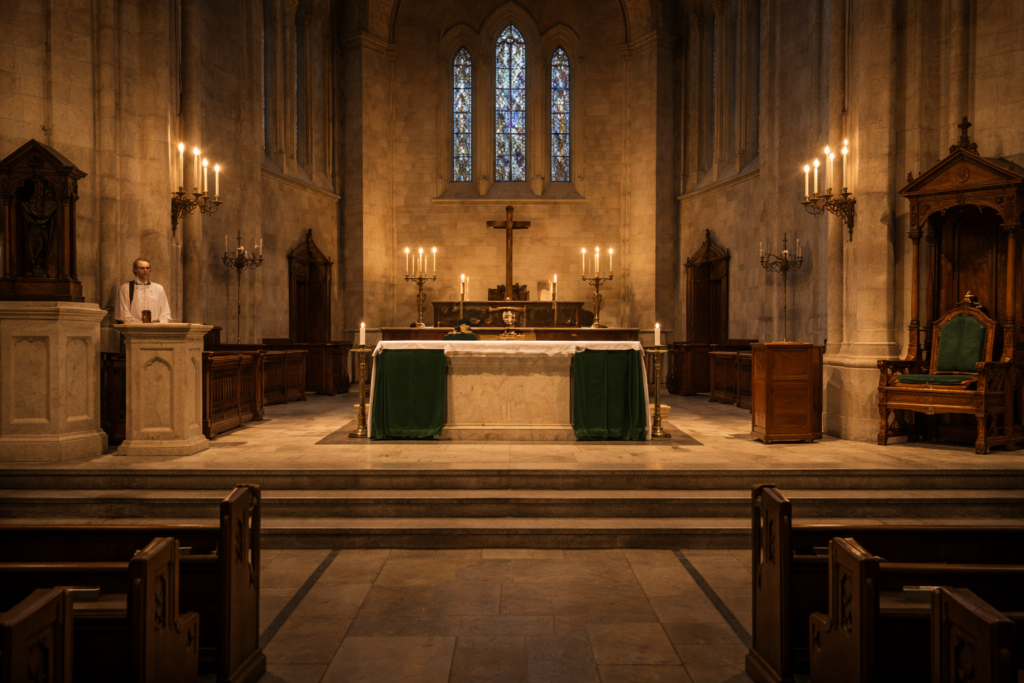
Given this the 16th day of August in the year of our Lord 2025
at The Basilica of Saint Longinus
By the Presiding Bishop
Ecclesiastical Greeting
Brandon, Presiding Bishop of the Holy Catholic Church of the Gospels, Bishop Ecclesiae of the Basilica of Saint Longinus the Centurion; ecclesiastical greetings to all Christian faithful and clergy in the name of our Lord Jesus Christ, Savior and liberator of all persons. Grace and Peace to you all.
Introduction
As head of this Church, I spend much of my time defending the marginalized, because the Gospel of our Lord Jesus Christ commands his disciples to take up these very causes. To bind the brokenhearted, to proclaim liberty to the captives, to comfort those who mourn, and to proclaim the year of the Lord’s favor; this is not the work of a few, but the calling of the whole Body of Christ (Isaiah 61:1–2; Luke 4:18–19). To stand with the bruised reed and the smoldering wick is not optional; it is the very heart of discipleship.
Yet, in our own day, there festers a malignant cancer in the Body of Christ. It spreads like wildfire, cloaked in the garments of righteousness but rotting the marrow of the Gospel itself. It is a counterfeit Christianity, an unholy trinity of errors that betray the Cross while professing to carry it. It is a religious nihilism, an idolatry that has enthroned human pride where Christ alone must reign.
This corruption has not sprung from one source alone. It is not a single blemish to be easily cleansed. It is a cluster of tumors, multiplying within the very body of the faithful. Among these are: Christian Nationalism, which confuses the Kingdom of Heaven with the kingdoms of men, and binds the eternal Gospel to passing banners and borders; Christian Condemnation, which presumes to sit upon the throne of judgment that belongs to God alone, and in doing so crucifies the innocent anew; Christian Hypocrisy, which cloaks sin in piety, wounds with one hand while blessing with the other, and thus silences the Gospel by corrupting it; and Christian Exclusionism, which dares to bolt shut the doors of the Kingdom against those whom Christ himself has welcomed and called beloved.
These tumors are not new. They are as old as the Pharisees who tithed mint and dill while neglecting justice and mercy (Matthew 23:23). But in our time their spread has become more virulent, more bold, more destructive. They choke the witness of Christ. They devour the weak and despised. They deceive even the elect. And if they are not rebuked, resisted, and excised, they will destroy the very body they claim to serve.
But take courage, beloved. The Lord of the Church has not abandoned his Bride. Where there is corruption, his Spirit convicts. Where there is exclusion, his mercy breaks down the walls. Where there is hypocrisy, his truth burns like fire to purify. And where nationalism dares to enthrone itself, Christ proclaims once more: “My kingdom is not of this world” (John 18:36).
The task before us is not easy. It is to name these evils clearly, to rebuke them in the name of Christ, and to call the faithful back to the true Gospel that sets captives free. It is to remember that the Church of the Living God cannot serve two masters—hatred and love, Caesar and Christ, exclusion and welcome. We must choose this day whom we will serve (Joshua 24:15). “As for me and my House,” as the verse says, “we will serve the Lord.” This is the personal Motto of my family, and the verse I steer my ship according to.
Among the tumors in the body of Christ, is the case Davis v. Ermold, brought by a fellow Christian, Kimberly “Kim” Davis. We all know her story: the Kentucky clerk who refused to issue marriage licenses to same-sex couples because of her religious conviction. She stands upon her Christian faith with a zeal and a passion which, in truth, I wish every member of the Church would cultivate. For zeal for the Lord is not to be despised. The fire that burned in the prophets, the boldness that led Peter to proclaim Christ before kings, such fervor is a gift.
Yet zeal is never enough. For zeal without knowledge, zeal without love, zeal without truth, is a sword unsheathed in the wrong direction. As Saint Paul himself wrote of his own people, “For I bear them witness that they have a zeal for God, but not according to knowledge” (Romans 10:2). This misguided zeal crucified the prophets. This zeal hunted the early Church. And this same zeal now wounds the Body of Christ by denying God’s image in our LGBTQ+ brothers and sisters.
Kim Davis believed she was defending righteousness. But in truth, she was denying justice. The Lord does not require us to deny others their civil rights in order to maintain our own faith. God does not command us to block the path of love, fidelity, and covenant. Nowhere in the Gospels does Christ ask his disciples to seize the levers of Caesar to enforce private conviction. Instead, he tells us plainly: “Render unto Caesar the things that are Caesar’s, and to God the things that are God’s” (Mark 12:17).
Marriage, as a civil institution, belongs to the realm of Caesar. Faithfulness, as a holy covenant, belongs to God. When we confuse these realms, we turn faith into compulsion and love into law. This is not the way of Christ. Christ did not coerce love, he wooed it. He did not impose faith, he invited it. He did not deny life or liberty to those who stood apart from him, he laid down his own life for their sake.
And so I say with grief but also with clarity: Kim Davis’s actions were not an act of holy witness, but of false martyrdom. They proclaimed not the love of Christ, but the rejection of neighbor. They declared not the freedom of conscience, but the bondage of exclusion. The true scandal of her defiance was not that she suffered legal consequence, but that in her suffering she believed she bore Christ’s Cross, when in fact she was placing crosses upon the backs of others.
The Cross of Christ is not a weapon to deny others their dignity. It is the altar upon which God gave everything to restore that dignity. To bear the Cross is to suffer with others, not to cause others to suffer. To bear the Cross is to give life, not to withhold it. Therefore, any use of faith to deny justice is not discipleship but distortion. It is zeal without love, which the Apostle reminds us is but a clanging cymbal (1 Corinthians 13:1).
- Sinful Condemnation
In the Gospels we hear Christ himself say: “Judge not, lest you be judged. For with the measure you use, it will be measured back to you.” (Matthew 7:1–2; Luke 6:37–38). In these words, Christ reveals a terrible and beautiful truth: the standard by which we condemn others will be the very standard by which God condemns us. He will turn our measures on their head and hold us to higher ones still.
If you condemn the poor because they are homeless, hungry, or unemployed, God will measure you by their condition. For all wealth belongs to the Lord, and before his throne we are all paupers. If you condemn others for being poorer than you, remember that God is infinitely richer than you and can judge you by the same harshness you used.
If you condemn someone for their marriage, remember that God sees every covenant and every heart. He will measure your marriage against his own perfection. If you ever harbored an impure thought or lust, God, who is pure, will judge you by that lack. If you ever betrayed a spouse or divorced for reasons other than abuse or adultery, he will hold you to his standard of unbroken faithfulness (cf. Matthew 5:27–32; Matthew 19:3–9).
If you condemn others as criminals, remember that God has never broken a single law. All law flows from his eternal justice, and before him we all stand as transgressors. What man-made court has not condemned us in some way? What mortal conscience has not faltered? We are all criminals in the sight of the Holy One (Romans 3:23).
Christ himself sharpened this warning in the parable of the unforgiving servant (Matthew 18:23–35). Though his great debt was forgiven, he refused to forgive the smaller debt of another. And so his pardon was revoked, and he was cast into judgment. Let us be clear: forgiveness blots out sin. The Church has taught this rightly for centuries. But she has too often forgotten the other side of Christ’s command; that if we withhold forgiveness, the forgiveness given to us is undone. What God has blotted out will be written again against us if we will not forgive our neighbor (Matthew 6:14–15).
Therefore, condemnation has no place in the Christian life. None. Condemnation belongs to God alone, and to presume it for ourselves is to grasp at divinity we do not possess. We are too frail, too biased, too corrupt in heart to judge without sin. Only the all-knowing, all-loving Lord can judge rightly (James 4:12).
How then can we condemn, when the Risen Lord refused to? How can we dare to wield the name of Jesus like a weapon, when he came not to condemn but to liberate (John 3:17)? It is not enough to call him “Savior.” Even the demons believe and tremble (James 2:19). It is not enough to proclaim his death and resurrection. The demons know that, too. The difference between us and them is this: we follow him. We walk in his way. We obey his voice (John 10:27).
Christ dined with the untouchables of his day (Mark 2:15–17). He revealed himself first not to the religious elite but to a Samaritan woman (John 4:7–26). In today’s world, this would be as if Jesus revealed himself to a Muslim in the midst of Christian hostility. Jews and Samaritans worshiped the same God but were divided by deep hostility; each claiming the other worshiped wrongly. We hear the echoes of this division when James and John asked Jesus if they should call down fire from heaven to destroy a Samaritan village (Luke 9:51–55). Jesus rebuked them sharply. He would not allow such hatred to masquerade as zeal.
Even more, Christ refused to condemn the woman caught in adultery. By the Law of Moses she deserved stoning (Leviticus 20:10; Deuteronomy 22:22). Yet Christ laid down a new measure: “Let the one who is without sin cast the first stone.” (John 8:7). And here lies the glory of the moment: there was indeed one among them who could have cast a stone. Jesus. He alone was without sin (Hebrews 4:15). and yet he refused. He would not raise a hand against her but instead gave her back her life and called her to repentance (John 8:10–11). If even the Sinless One would not lift a stone, how much less we, who are drenched in sin, should ever dare to pick one up.
- Demonic Nationalism
So-called “Christian Nationalism” ought to be named what it truly is: Demonic Nationalism. For what it prescribes is not righteousness but evil, and I do not hesitate to say I believe it is inspired by Satan himself. Perhaps this sounds startling. Perhaps some will accuse me of exaggeration. But let us be honest: Scripture warns us that the devil disguises himself as an angel of light (2 Corinthians 11:14). He does not come to the faithful in horns and fire, but in words that sound holy, in banners cloaked with piety, in a false gospel draped in patriotic fervor.
You cannot serve two masters. You cannot serve Christ and the nation. You cannot worship the Lamb of God and the golden calf of patriotism. For Christ himself declared: “No one can serve two masters. Either you will hate the one and love the other, or you will be devoted to the one and despise the other” (Matthew 6:24). The gospel is not “Christ and Country.” It is Christ alone. Anything else is idolatry, and idolatry has no place in the Kingdom of Heaven.
Christ never sought an earthly theocracy, though his people longed for one. The Jews of his day wanted a Messiah to overthrow Rome, to establish Israel’s throne, to restore the nation’s power. But Jesus rebuked those desires. When the crowds tried to make him king by force, he withdrew to the mountain alone (John 6:15). When asked about paying taxes to Caesar, he did not call for rebellion or theocracy; he said, “Render unto Caesar what is Caesar’s, and to God what is God’s” (Mark 12:17). And what belongs to God? All of it. Every life. Every soul. Every breath. Christ would not trade the eternal kingdom for the dust of earthly power.
Even among his disciples, zealots burned with nationalist fire. Simon the Zealot surely hoped Jesus would lead an armed revolt. Yet Christ rebuked every attempt to cloak the gospel in swords and politics. When Peter drew his blade in Gethsemane, Christ ordered him to sheath it: “Those who live by the sword will die by the sword” (Matthew 26:52). He chose instead to walk willingly to the Cross, proving that the kingdom of God is not won by violence or national pride but by self-giving love.
And let us not forget: the Jewish nation itself was a theocracy, ruled under divine law, yet Christ rebuked its leaders most fiercely. To the Pharisees, who turned law into power and nationalism into religion, he spoke words of fire: “You shut the kingdom of heaven in men’s faces. You yourselves do not enter, nor will you let those enter who are trying to” (Matthew 23:13). If Christ rebuked his own nation’s theocratic pride, do you think he blesses ours? No. He does not. He warns us with the same judgment.
Christ never promised us a Christian nation. He promised us a Cross. He never commanded us to conquer, but to serve. He never called us to build earthly empires, but to proclaim a heavenly kingdom not of this world (John 18:36). The gospel of nationalism is a lie, for Christ does not share his glory with America, Rome, or any other nation under heaven. His kingdom is eternal. His throne is already filled. And he will not abdicate it for any flag, any constitution, or any court.
Every Christian confesses, in some form, a belief about the end of days. And Scripture is plain that in those days “even the elect, if possible, will be led astray” (Matthew 24:24). The question has haunted me: how could this be? How could faithful men and women, vigilant for the signs, fall prey to the Antichrist? How could those who claim Christ be seduced by Satan?
The answer is written already in Christ’s own words. “Strait is the gate, and narrow is the way which leadeth unto life, and few there be that find it. Wide is the gate, and broad is the way, that leadeth to destruction, and many there be which go in thereat” (Matthew 7:13–14). He warned us further: “Not everyone that saith unto me, Lord, Lord, shall enter into the kingdom of heaven” (Matthew 7:21). On the day of judgment, there will be multitudes who say, “Lord, we cast out demons in your name, we prophesied in your name, we built nations in your name.” And Christ will answer them: “Depart from me, I never knew you” (Matthew 7:23).
This is not speculation; it is the Lord’s own teaching. The chilling truth is this: the greatest danger to Christianity does not come from atheism, or Islam, or secularism. It comes from within. It comes when Christians twist the name of Christ into a weapon for their own ideology. It comes when believers abandon the Gospel for a worldview dressed up in Scripture but emptied of love.
Paul prophesied of this day: “For the time will come when they will not endure sound doctrine; but after their own lusts shall they heap to themselves teachers, having itching ears. And they shall turn away their ears from the truth, and shall be turned unto fables” (2 Timothy 4:3–4). Look around, and tell me this is not what we see. Congregations abandon churches that labor in the Word, that teach the hard sayings of Christ, that wrestle with Scripture in its depth. They trade them for movements that promise power, certainty, and worldly triumph. They exchange sound doctrine for a gospel that promises them crowns without crosses, glory without repentance, salvation without transformation.
These movements call themselves “Bible-believing” while ignoring the very heart of the Gospel. They proclaim that “accepting Jesus” is enough, while refusing to accept his teachings. They promise heaven while demanding no holiness. They tell people that Christ celebrates their worldview rather than crucifies it. They preach that one can serve both God and mammon, that faith and nationalism are the same, that the Kingdom of Heaven is nothing more than the kingdom of America dressed up with stained glass.
Beloved, do not be deceived. This is not Christianity. It is apostasy. It is the golden calf of our age, crafted not of gold but of flags and slogans, a false god to which the people bow while still calling it by the Lord’s name. And like the calf in the wilderness, it was not born of unbelief, but of impatience, fear, and the desire for a god who looks like us, who blesses our nation, our politics, our prejudices. But the God of Abraham, Isaac, and Jacob will not be mocked. Christ will not share his throne with Caesar.
Make no mistake: Satan has touched Christianity in our time. He has inspired preachers and politicians alike to birth churches and movements that grow rapidly, not because they are rooted in the Gospel, but because they flatter the ears of the powerful. Their teachings are not tested against the wisdom of centuries, nor the labor of saints, nor the consensus of the faithful across nations and time. Instead, they are shallow readings, convenient distortions, cherry-picked verses twisted into weapons. And because these words suit the culture wars of the age, millions flock to them.
But hear me: the Devil’s most effective work is not in pulling people away from the Church, but in convincing them they are serving Christ while in fact serving him. The most dangerous heresies are not outside the Body of Christ, but tumors within it. And Christian nationalism is one such tumor, malignant, spreading, and deadly to the witness of the Gospel.
The numbers themselves bear witness to the truth of Christ and Paul’s warnings. The research of our age reveals that the Catholic Church has suffered enormous losses, with more than eight leaving for every one who joins. Among those who depart, more than half become unaffiliated, counting themselves among the so-called “nones.” The rest scatter, some toward mainline Protestantism, some toward evangelical or non-denominational churches, others even outside Christianity altogether.
Mainline Protestants, who for generations have wrestled faithfully with Scripture and sought to walk with integrity on issues of human dignity, are shrinking at historic rates. From nearly one in five Americans only a generation ago, they now number scarcely one in ten. And who fills their pews when they are emptied? They do not remain vacant. Forty percent of those who now call themselves evangelicals once sat in mainline churches. Thirty-five percent of new evangelicals were once Catholic. Even the unaffiliated themselves feed the evangelical ranks, for nearly one in five evangelicals today once had no faith at all.
What does this tell us? It shows that the broad road Christ warned of is not simply the road of unbelief. It is also the road paved with zeal but stripped of love. The very churches most faithful to the command of Christ, “whatever you do to the least of these, you do to me,” are hemorrhaging members. Meanwhile, churches that reject the poor, the immigrant, the queer, and the marginalized grow like wildfire. Satan is cunning. He knows how to reap a harvest. He knows that growth does not mean holiness, and numbers do not prove faithfulness. Even God has never called him stupid or careless, only evil. And here we see why: for Satan has succeeded in making many believe that numerical increase is proof of divine favor, when in truth it is nothing but a swelling of pride, the wide road to destruction.
Paul spoke of this day when he warned Timothy that in the end “people will not put up with sound doctrine, but will gather teachers to suit their own desires” (2 Tim. 4:3). Christ himself warned us that not all who cry “Lord, Lord” will enter the kingdom of heaven (Matt. 7:21). This is what we are witnessing. The gates of hell are not prevailing against the Church, but they are thinning her ranks, sifting out the wheat from the chaff. Satan is driving this car off the cliff, and far too many passengers cheer him on because they think the speed of the ride proves the blessing of God.
Beloved, I say this not to gloat over decline, but to warn with tears: these trends do not disprove Christ, they prove him. They do not negate Paul’s warning, they fulfill it. The Body of Christ is not being defeated; it is being refined.
To put this plainly, Satan has dressed himself in the costume of a white, conservative Jesus. He parades in fine clothes, flashes wealth, promises safety, and whispers lies that sound like righteousness. He does not ride the humble donkey of Palm Sunday; he drives the sleek Porsche of pride and greed. And multitudes follow him, not because they knowingly follow Satan, but because they have never dared to question the one leading them.
He sings to them a gospel of condemnation. He preaches that riches are blessing and poverty is curse. He points to his overflowing accounts and calls it favor, while Christ pointed to the Cross and called it glory. His words drip with Bible verses; for yes, he knows the Scriptures, for he stood present when they were written. But as in the wilderness, when he tempted our Lord, his verses are always severed, hollowed, and bent away from the heart of God.
Remember: Satan told Jesus to cast himself down from the Temple’s pinnacle, quoting Psalm 91, “He will command his angels concerning you… they will lift you up, so you will not dash your foot against a stone.” But Christ would not allow the serpent to twist the Word. He replied with the fullness of the Law: “You shall not put the Lord your God to the test” (Deut. 6:16). Every verse Satan misquoted, Jesus completed. Every half-truth, Jesus rebuked with the whole truth.
Beloved, we must do the same. Do not be lulled to sleep by the devil’s lullabies of prosperity and exclusion. Do not feed on half-verses and proof-texts that excuse cruelty. Test every word against the whole Christ. Ask yourself: does this voice sound like the Shepherd who laid down his life for the sheep, or does it sound like the thief who comes to steal, kill, and destroy (John 10:10-11)?
Christ never promised wealth. He promised a Cross. He never promised acceptance by the world, but warned that the world would hate us for his name. He never commanded us to condemn, but to forgive. He never called us to luxury, but to servanthood.
So hear this warning in all its clarity: if the “Jesus” you follow blesses your greed, fuels your hate, mocks the poor, and despises the broken, then you are not following Jesus of Nazareth. You are following the devil in Jesus’ clothing. And that devil is not walking a narrow path; he is driving a Porsche straight toward a cliff. The warning signs are all around: Bridge Out, Road Ends, Danger Ahead. But those signs are ignored in the rush of speed, the thrill of the ride, the music blaring in the ears. It looks like a scene from the Dukes of Hazzard or a cartoon with the Road Runner; barreling toward an edge with reckless confidence. But hear me: there will be no miracle jump, no bridge appearing out of thin air, no cartoon landing where the car floats safely to the other side. There will be a crash. There will be a fall. And the fall will be great.
Beloved, Christ told us the gate is narrow and the way is hard that leads to life. That road is not flashy, it does not glitter, it is not paved with slogans and stadium lights. It is marked by humility, sacrifice, and love. Let no one deceive you: the wide road, the roaring Porsche, the gospel of exclusion; it all ends in ruin.
Therefore, cling to the Shepherd. Do not follow the counterfeit Christ with his hollow verses and golden promises. Follow the Lamb of God who bore our sins. Follow the Lord who lifted the broken and ate with outcasts. Follow the Savior who refused to cast a stone, even when he alone was worthy. For only on that narrow road, thorny though it is, do we find life.
And let us remember this above all: on the Day of Judgment, the books of heaven will not weigh how fiercely we condemned, but how faithfully we loved. For in the end, we will not be judged for loving too many or too much, but rather for loving too few and too little.
- Christian Hypocrisy and Apostacy
The third tumor festering in the Body of Christ is hypocrisy, and with it, its twin: apostasy. These are the devil’s favorite offspring, for he feeds upon hypocrisy and drinks deeply of apostasy. Where hypocrisy thrives, faith withers. Where apostasy reigns, truth is trampled in the streets.
Satan delights when Christians preach mercy yet practice cruelty, when they condemn in public what they themselves commit in secret. Hypocrisy is the serpent’s sweetest fruit, for it does more damage than outright unbelief. An atheist may deny Christ, but the hypocrite blasphemes him while still bearing his name. The atheist wounds the Church from outside, but the hypocrite rots her from within.
Christ himself reserved his fiercest words not for Rome, nor for the pagans, but for the hypocrites of his own people. “Woe to you, scribes and Pharisees, hypocrites!” he cried, “for you tithe mint and dill and cumin, and have neglected the weightier matters of the law: justice and mercy and faithfulness” (Matthew 23:23). He called them whitewashed tombs; beautiful on the outside, but inside full of dead men’s bones (Matthew 23:27). And is this not what hypocrisy is? A rotting corpse, painted over with piety, reeking still before the throne of God.
And what of apostasy? Apostasy is not merely leaving the Church, as some imagine. It is the slow turning of the heart away from Christ while still mouthing his name. It is the betrayal of Judas: still sitting at the table, still kissing the cheek of the Savior, while the soul has already fled into darkness. Apostasy is when a Christian abandons sound doctrine for the comforts of culture, when they exchange the hard road of discipleship for the wide road of convenience. It is when preachers tickle itching ears, proclaiming crowns without crosses, grace without repentance, love without truth (2 Timothy 4:3–4).
These twin tumors, hypocrisy and apostasy, feed one another. Hypocrisy leads to apostasy, for no soul can long bear the dissonance of pretending to follow Christ while refusing his way. Apostasy breeds hypocrisy, for those who reject the narrow path must still keep up appearances among the faithful. And together they spread like gangrene, poisoning whole congregations until unbelievers look upon the Church and see not the face of Christ but the mask of fraud.
Is it any wonder, then, that millions flee the pews? They do not flee Christ, they flee hypocrisy. They do not despise the Gospel, they despise its distortion. Clergy who cover up abuse while preaching purity. Congregations who sing hymns to the God of love while despising their neighbor. Leaders who preach sacrifice while living in luxury. This hypocrisy has led to apostasy, and the apostasy has birthed disillusionment, scattering the sheep into the wilderness of unbelief.
Beloved, hear me: hypocrisy and apostasy are not merely private sins. They are public scandals. They are cancers in the Body of Christ. Every time the Church preaches compassion but practices cruelty, she does not merely tarnish her witness; she drives a soul toward despair. And when that despair becomes unbelief, it is not the wounded one who bears the judgment, but the one who inflicted the wound. Did not our Lord himself say, “Whoever causes one of these little ones who believe in me to stumble, it would be better for him to have a great millstone fastened around his neck and to be drowned in the depth of the sea” (Matthew 18:6)?
The judgment of God does not fall on the broken who limp away from the Church in grief. It falls on those who broke them. It does not fall on the lamb who wanders from the fold in sorrow, but on the shepherd who beat him with the rod instead of carrying him on his shoulders. Woe to the Church that drives the wounded from Christ’s side. Woe to the preacher who heaps stones on bruised reeds and calls it holiness. For Christ himself will require their blood at our hands.
Therefore, the words of Christ must burn in our ears: “Woe to you, hypocrites!” For hypocrisy is not a minor failing; it is a denial of the Cross. Apostasy is not merely drifting away; it is treason against the Kingdom. Together they are the greatest threat to the Church, greater than persecution, greater than secularism, greater than any force outside her walls. For the devil knows this truth: the Body of Christ cannot be destroyed from without, but she can be hollowed from within.
Beloved, hypocrisy and apostasy are never isolated. They spread outward, infecting others. And what of teachers? Scripture makes it plain: those who teach, lead, and shepherd are held to the highest account when they cause harm.
James, the brother of our Lord, warns us bluntly: “Not many of you should become teachers, my brothers, for you know that we who teach will be judged with greater strictness” (James 3:1). Greater strictness! If every Christian will stand before the judgment seat of Christ (2 Corinthians 5:10), then how much more will those who claimed the title of pastor, priest, or bishop be weighed for the souls entrusted to them?
Our Lord himself declared, “Whoever causes one of these little ones who believe in me to stumble, it would be better for him to have a great millstone fastened around his neck and to be drowned in the depth of the sea” (Matthew 18:6; Luke 17:2). The millstone, not for the wounded one who staggered away, but for the one who tripped them. The sea, not for the lamb who limped from the fold, but for the shepherd who struck them with the staff. Christ does not equivocate here; better to die than to make another lose faith in him.
And hear the Lord’s words through the prophet Ezekiel: “Son of man, I have made you a watchman for the house of Israel. If you do not warn the wicked… their blood I will require at your hand” (Ezekiel 3:17–18). The shepherd who refuses to protect the sheep, the preacher who refuses to warn the flock, the leader who hides sin and cloaks abuse; they do not only fail their office, they bring upon themselves the guilt of the ones destroyed. Their hands are stained with blood.
This is why Christ reserved his harshest rebukes not for prostitutes or tax collectors, but for the religious leaders of his own people. To the scribes and Pharisees he thundered: “Woe to you! You shut the kingdom of heaven in people’s faces. You yourselves do not enter, nor will you let those enter who are trying to” (Matthew 23:13). The very ones who claimed to guide the people of God were in fact slamming the door of salvation shut.
What then can be said of Christian leaders today who preach inclusion but practice exclusion, who speak of holiness but conceal corruption, who proclaim mercy but deal in condemnation? Theirs is not merely hypocrisy; it is apostasy. They are not stumbling themselves alone; they are dragging the souls of others down with them. And their judgment will be heavier for it.
Beloved, hypocrisy and apostasy today are not nameless abstractions. They have pulpits. They have microphones. They sell books and stream sermons with millions of views. Their poison is slickly packaged, their corruption dressed in designer suits and staged lighting.
Who are today’s scribes and Pharisees? They are the prosperity preachers who promise heaven but sell it for a “seed offering.” They claim that wealth is God’s blessing while wringing the last coin from the poor widow’s purse. They stand in the line of those Christ rebuked for “devouring widows’ houses and for a show make lengthy prayers” (Mark 12:40). Their prayers may trend online, but their judgment is coming.
They are the nationalist pastors who drape the Cross with the flag and mistake Caesar for Christ. They thunder condemnation against immigrants, Muslims, and queer people, yet call it “defending the faith.” They lead their congregations not into the Kingdom of Heaven, but into the cult of power. And for every lamb who stumbles away from Christ because of their venom, a millstone awaits.
They are the bishops and priests who cover up abuse in the Church, shifting predators from one parish to another. They stand in pulpits preaching purity while their silence multiplies victims. They dare to call themselves shepherds, yet Christ himself names them: “The hired hand is not the shepherd and does not own the sheep. So when he sees the wolf coming, he abandons the sheep and runs away” (John 10:12). Worse, some do not merely abandon, they invite the wolf in. Their blood-guilt cries to heaven, and the Judge of all the earth will answer it.
They are also the Pharisees of our digital age; Christians who wield the Bible like a club in comment sections, who tweet curses in Jesus’ name, who exalt their “rightness” over the person before them. Christ warned us of such zeal without love. “They tie up heavy, cumbersome loads and put them on other people’s shoulders, but they themselves are not willing to lift a finger to move them” (Matthew 23:4). The internet has become their temple court, and their words have become stumbling blocks to millions.
Let us be clear: those who abandon Christ because of wounds inflicted by his so-called followers are not the condemned. They are the victims of wolves in shepherd’s clothing. If they wander, it is because they were driven from the fold, not because they hated the Shepherd. Christ himself holds the millstone for those who cast them out.
And so I say again: hypocrisy and apostasy are not merely private sins. They are public scandals. Every time the Church preaches compassion but practices cruelty, she drives another soul into Satan’s arms. Every time a preacher declares “all are welcome” but means “all who look like us, vote like us, love like us,” another door to heaven is slammed in someone’s face. And woe, woe, to those who shut a door Christ himself flung open with his blood.
IV. Christian Exclusion and the False Martyrdom of Davis v. Ermold
There are twin tumors again here, in the exclusion of persons from the kingdom of heaven and the current Supreme Court case Davis v. Ermold which looks to ask the High Court to overturn marriage equality.
There is a claim often repeated by exclusionists, that marriage is a Christian institution and therefore must be defined and guarded by the Church. But let us be clear: marriage long predates Christianity. Civil marriage is not a sacrament; it is a contract recognized by the state. Governments across history have married men and women without the blessing of Christ, and many marriages in Scripture itself took place without a priest, a synagogue, or a church. Marriage, as covenant before God, is holy. But marriage, as contract before Caesar, belongs to Caesar. To confuse the two is to twist both.
Kim Davis did not simply refuse to act on personal conviction. She violated her oath of office and defied the Supreme Court of the United States, which had ruled that same-sex couples have the right to civil marriage. In that moment she ceased to be a public servant and instead made herself a stumbling block. Her actions were not an act of faith but an act of lawlessness.
History gives us clear parallels. When Governor George Wallace stood in the doorway of the University of Alabama to block the enrollment of Black students after segregation had been struck down, he was not defending states’ rights. He was defying the law. When Governor Orval Faubus called out the Arkansas National Guard to block the Little Rock Nine from entering Central High School, he was not protecting tradition. He was violating justice. Kim Davis stood in the same doorway, blocking couples who had already been guaranteed their rights by the highest court in the land. She may have believed she was serving God, but in truth she was standing with Wallace and Faubus against justice, against freedom, and against the very Constitution she swore to uphold.
And here is the deeper truth: the moment one accepts a public office, one accepts the duty to uphold the law of Caesar. Matthew the tax collector knew this well. Though he was a Jew and a follower of the Law of Moses, when he sat in the tax booth he collected for Caesar. If he had tried to use his faith as a shield to refuse his duties, he would not have been celebrated. He would have been executed. He knew the cost of serving Caesar. He bore it until Christ called him to leave the booth altogether. Kim Davis also knew the cost when she took her oath. She swore to uphold the Constitution, not to baptize it in her theology. She could have resigned in protest, as countless faithful servants have done when conscience conflicted with duty. But she did not resign. She remained in Caesar’s chair while refusing to do Caesar’s work.
Christ himself taught us: “Render unto Caesar what is Caesar’s, and unto God what is God’s.” Davis wanted both—she wanted Caesar’s paycheck and God’s authority. But you cannot serve both. If your conscience forbids you from Caesar’s work, then you leave Caesar’s service. You do not warp Caesar’s law in Christ’s name.
This is the hard word exclusionists do not want to hear: God does not need us to deny civil rights in order to preserve his holiness. God does not command us to strip others of their dignity in order to defend his covenant. The Cross is not a weapon to enforce belief. It is the altar of sacrifice where Christ laid down his life for all, not just for those who conformed.
So let us be honest. Davis was not a martyr. She was not a prophet. She was a clerk who chose disobedience not to God, but to the Constitution she swore to uphold. Her actions did not sanctify marriage. They desecrated justice. And when the world saw her stand in that doorway, they did not see Christ the Bridegroom. They saw the face of exclusion, of hypocrisy, and of a Church that too often mistakes oppression for witness.
But let us not deceive ourselves into thinking this story is only about one clerk in Kentucky. Kim Davis is but one face of a far deeper sickness, a tumor that runs through much of the Church in our time. This is the sin of exclusionism, the belief that the Body of Christ belongs to some and not to others, that the Kingdom of God is a gated community with locks and guards and carefully curated guest lists.
Exclusionism is not new. The Pharisees practiced it when they rebuked Jesus for dining with tax collectors and sinners (Mark 2:15–17). The disciples stumbled into it when they tried to forbid children from coming to him, and Christ rebuked them, saying, “Let the little children come to me, and do not hinder them” (Matthew 19:14). The early Church battled it when Jewish believers demanded that Gentiles be circumcised and keep the whole Law of Moses before being baptized. And the apostles, under the Spirit’s guidance, thundered against it. Peter declared, “Why do you test God by putting on the necks of the disciples a yoke that neither we nor our ancestors have been able to bear? No, we believe it is through the grace of our Lord Jesus that we are saved, just as they are” (Acts 15:10–11).
Paul himself confronted Peter when Peter withdrew from Gentile believers out of fear of the circumcision party. Paul wrote: “When I saw that they were not acting in line with the truth of the gospel, I opposed him to his face” (Galatians 2:14). Why? Because to exclude those whom Christ had welcomed was to nullify the Cross. Paul reminded the Galatians that in Christ “there is neither Jew nor Greek, slave nor free, male nor female, for you are all one in Christ Jesus” (Galatians 3:28). To divide where Christ had united was, in Paul’s eyes, apostasy itself.
Exclusionism is always a denial of grace. It is the arrogance of those who forget that they too were once strangers and outcasts. Israel was commanded: “You shall love the stranger, for you were strangers in the land of Egypt” (Deuteronomy 10:19). Christ sharpened this further in the parable of the Sheep and the Goats: the eternal judgment does not rest on theological precision or national loyalty, but on how we treated the hungry, the naked, the prisoner, the stranger (Matthew 25:31–46). The measure of faith is love, and the measure of love is inclusion.
Beloved, hear me: when the Church excludes, she ceases to be the Bride of Christ and becomes instead the jailer of the Gospel. She shuts the very doors Christ flung wide open. Worse still, she risks placing millstones around her own neck. For did not Christ say, “If anyone causes one of these little ones who believe in me to stumble, it would be better for them to have a large millstone hung around their neck and to be drowned in the depths of the sea”? (Matthew 18:6). To exclude the marginalized, to shut out the queer child, to silence the questions of the doubter, is to drive them not into holiness but into despair. And Christ himself warns that such stumbling blocks provoke his fiercest judgment.
Exclusionism is not faithfulness. It is fear. It is the fear that God’s grace will prove bigger than our boundaries, that the Spirit will fall upon those we do not approve, that Christ will save those we have deemed unsavable. But Scripture is relentless on this point: the Spirit blows where it wills (John 3:8). The Gospel cannot be chained (2 Timothy 2:9). No wall, no doctrine of exclusion, no decree of man can keep Christ from seeking the lost.
Therefore, exclusionism is not only unfaithful, it is futile. For Christ himself declares, “I am the door. Whoever enters through me will be saved” (John 10:9). And when he opens a door, no one can shut it (Revelation 3:7). Woe, then, to the Church that tries to bolt what Christ has opened. Woe to the Christians who mistake the Bridegroom’s welcome for a private club.
The Body of Christ was never meant to be a fortress against sinners. It was meant to be a hospital for them. The Church is not holy because she keeps out the broken, but because she welcomes them and lets the Great Physician heal them. Every exclusion is a denial of the Physician’s work, a refusal to let Christ do what he came to do: “to seek and to save that which was lost” (Luke 19:10).
So let us name exclusionism for what it is. It is not holiness. It is not righteousness. It is not faith. It is sin. It is the sin of the elder brother who sulked outside the Father’s house, angry that grace was given to the prodigal (Luke 15:28–30). It is the sin of Jonah, who pouted under the vine because God had mercy on Nineveh (Jonah 4:1–2). It is the sin of the Pharisees, who sneered because Christ welcomed sinners and ate with them.
Beloved, let us hear Christ’s words anew: “I desire mercy, not sacrifice” (Hosea 6:6; Matthew 9:13). Mercy is the heart of God. Exclusion is its betrayal. And the Church must choose, once and for all, whom she will resemble: the Pharisees with their locked doors, or the Savior who tore the veil and welcomed all into the presence of God.
- The Christian Dayenu
In the Jewish Passover tradition, there is a hymn called Dayenu, which means “it would have been enough.” It is sung as Israel recalls the mighty acts of God in the Exodus: if the Lord had brought us out of Egypt but not divided the sea, it would have been enough. If he had divided the sea but not given us the manna, it would have been enough. Each verse builds, not to diminish the fullness of God’s acts, but to magnify them. Each mercy, standing alone, would have been sufficient. Yet God gave more, and more still.
Beloved, we Christians are grafted into this heritage. We too confess that God’s mercies are beyond measure. And in Christ, we have seen mercies greater still. Therefore, let us take up this ancient form of praise and confess our faith in a Christian Dayenu. For if Christ had not done everything he did, it still would have been enough.
If Christ had been promised by the prophets, but had not come in the fullness of time, dayenu—it would have been enough.
If he had come in the fullness of time, but had not been born of the Virgin Mary, dayenu—it would have been enough.
If he had been born of Mary, but had not taken the form of a servant, dayenu—it would have been enough.
If he had taken the form of a servant, but had not grown in wisdom and stature before God and man, dayenu—it would have been enough.
If he had grown in wisdom and stature, but had not preached good news to the poor, dayenu—it would have been enough.
If he had preached good news to the poor, but had not healed the sick, opened blind eyes, and raised the dead, dayenu—it would have been enough.
If he had healed the sick and raised the dead, but had not cast out demons and set the captives free, dayenu—it would have been enough.
If he had cast out demons, but had not forgiven sins and eaten with sinners, dayenu—it would have been enough.
If he had forgiven sins, but had not calmed the storm and walked upon the sea, dayenu—it would have been enough.
If he had calmed the storm, but had not transfigured upon the mountain, revealing his glory to Peter, James, and John, dayenu—it would have been enough.
If he had been transfigured, but had not entered Jerusalem humble and riding on a donkey, dayenu—it would have been enough.
If he had entered Jerusalem, but had not washed his disciples’ feet, dayenu—it would have been enough.
If he had washed their feet, but had not given them his Body and Blood in the Supper, dayenu—it would have been enough.
If he had given them his Body and Blood, but had not prayed for them in Gethsemane, dayenu—it would have been enough.
If he had prayed in Gethsemane, but had not been betrayed with a kiss, dayenu—it would have been enough.
If he had been betrayed, but had not been falsely accused, spat upon, and scourged, dayenu—it would have been enough.
If he had been scourged, but had not borne the Cross upon his shoulders, dayenu—it would have been enough.
If he had borne the Cross, but had not been nailed to it, dayenu—it would have been enough.
If he had been nailed to the Cross, but had not spoken forgiveness to his enemies, dayenu—it would have been enough.
If he had spoken forgiveness, but had not given his Spirit into the Father’s hands, dayenu—it would have been enough.
If he had given up his Spirit, but had not torn the veil of the Temple, dayenu—it would have been enough.
If he had torn the veil, but had not been laid in Joseph’s tomb, dayenu—it would have been enough.
If he had been laid in the tomb, but had not descended to the dead to proclaim liberty to the captives, dayenu—it would have been enough.
If he had descended to the dead, but had not risen on the third day, dayenu—it would have been enough.
If he had risen, but had not appeared to Mary Magdalene, to the disciples, and to Thomas in his doubt, dayenu—it would have been enough.
If he had appeared, but had not restored Peter with threefold love, dayenu—it would have been enough.
If he had restored Peter, but had not ascended into heaven, dayenu—it would have been enough.
If he had ascended, but had not sent the Holy Spirit at Pentecost, dayenu—it would have been enough.
If he had sent the Spirit, but had not made us his Body, the Church, dayenu—it would have been enough.
If he had made us his Body, but had not promised to return in glory to judge the living and the dead, dayenu—it would have been enough.
If he had promised to return, but had not promised to wipe every tear from our eyes and make all things new, dayenu—it would have been enough.
But Christ has done all this—and more. Therefore, let heaven and earth proclaim: his grace is sufficient, his love is without end, his mercy endures forever.
Beloved, this is why we cannot exclude, why we cannot condemn, why we cannot bow to nationalism or hypocrisy. For if each of Christ’s acts would have been enough, then what excuse do we have to withhold love, when love is the very fullness of his work? If the cross alone would have been enough, then what power do we have to deny others the fruits of that cross? If the Spirit poured out would have been enough, then who are we to quench that Spirit in our neighbor?
The truth is clear: every act of Christ’s love is already more than sufficient. And if it is sufficient for God, then it must be sufficient for us.
Let us pray,
Blessed are You, O Lord our God, King of the Universe, who made heaven and earth, who brought Israel out from the house of bondage, who gave the Law through Moses and spoke through the prophets.
Blessed are You, who in the fullness of time sent forth Your Son, born of a woman, born under the Law, to redeem those under the Law. Blessed are You, who raised him from the dead and seated him at Your right hand, that all nations might see the salvation of our God.
Let us not grow weary or faint. Help us choose this day whom we will serve. Help us walk in the narrow way. To hold fast the faith once delivered to the saints. To stand firm in the grace of Christ, for he is enough.
The night is far spent, the day is at hand. Cast off the works of darkness, and help us put on the armor of light. And above all, help us clothe ourselves with love, which is the bond of perfection.
May your peace, which passes all understanding, guard our hearts and minds in Christ Jesus, until the day when faith shall be sight, and love shall be all in all. Amen.
- Conclusion
Beloved in Christ, I have spoken with fire not because I hate, but because I love. One does not treat a cancer by politely asking it to go away. One does not cure a tumor by ignoring it or pretending it is harmless. A physician who loves the body must act with urgency, to cut away or ablate what corrupts. So too with the Body of Christ. Hypocrisy, exclusion, condemnation, and nationalism are not bruises to be bandaged; they are cancers to be removed. To ignore them is to let the whole body waste away. To confront them is not cruelty but love.
And so I have spoken as one who loves the Body of Christ. I will not stand idle while wolves devour the flock. I will not stand silent while tumors choke the life of the Gospel. For if one loves the Church Christ founded, one must fight for her health. Not with malice, not with violence, but with using truth to ablate, mercy as balm, and rebuke as a scalpel.
Make no mistake: I do not do this work is for my glory, but for God’s alone. The office entrusted to me, the authority given to me, the very breath in my lungs; I yield it all to Christ. And if obedience to Christ demands civil disobedience to Caesar, then so be it. I will take up my cross and follow where he leads.
If the courts of this nation overturn marriage equality, I will still bless and solemnize the covenants of same-sex couples, even if the state refuses to recognize them. If caring for the poor, the homeless, or the immigrant becomes a crime, I will not cease. If Caesar demands I bow before the altar of the nation, I will refuse, for I bow before the Lamb who sits upon the throne.
For I am not a county clerk like Kim Davis. I do not serve in Caesar’s employ. I am a bishop of Christ’s Church. My work is faith. My vocation is Gospel. My charge is the care of souls. Caesar may command armies and legislatures, but he cannot command my conscience, nor can he own the Bride of Christ. Caesar can control my freedom, but my obedience belongs to the triune God.
This world is not my home. My citizenship is in heaven (Philippians 3:20). While I sojourn here, I will do as my God commands: to do justice, to love mercy, and to walk humbly with my God (Micah 6:8). And when my pilgrimage is complete, I do not hope for applause or monuments. I hope only for this: that Christ will vouch for me, that my sins will be cleansed by grace, and that I may join the saints and angels in glory, crying “Holy, holy, holy” before the throne of the Triune God.
Until that day, I pledge this: I will not betray the Gospel of Christ for the favor of men. I will not trade the narrow way for the broad road of pride. I will not let tumors devour the Body without raising my voice. And if I fall, I will fall with the Cross in my hands and the name of Christ upon my lips.
Beloved, let us labor together for the healing of the Body, the glory of Christ, and the salvation of souls. For in the end, only love remains. And in the end, we will not be judged for loving too many or too much, but for loving too few and too little.
Amen.
Given at the Basilica of Saint Longinus, Mother Church of the Holy Catholic Church of the Gospels,
on this sixteenth day of August, in the year of our Lord two thousand twenty-five,
the second year of my episcopate as Presiding Bishop.
Under my hand and seal, I commend this encyclical to all clergy and faithful,
that it may be read, pondered, and carried into the life of the Church.
What is written here I entrust to the Spirit of God, who alone convicts and consoles,
and to Christ our Lord, who reigns forever as Shepherd and King.
In the Name of the Father, and of the Son, and of the Holy Spirit.
✠ Brandon
Presiding Bishop of the Holy Catholic Church of the Gospels
Bishop Ecclesiae of the Basilica of Saint Longinus the Centurion
Apostolus per Vocationem Dei